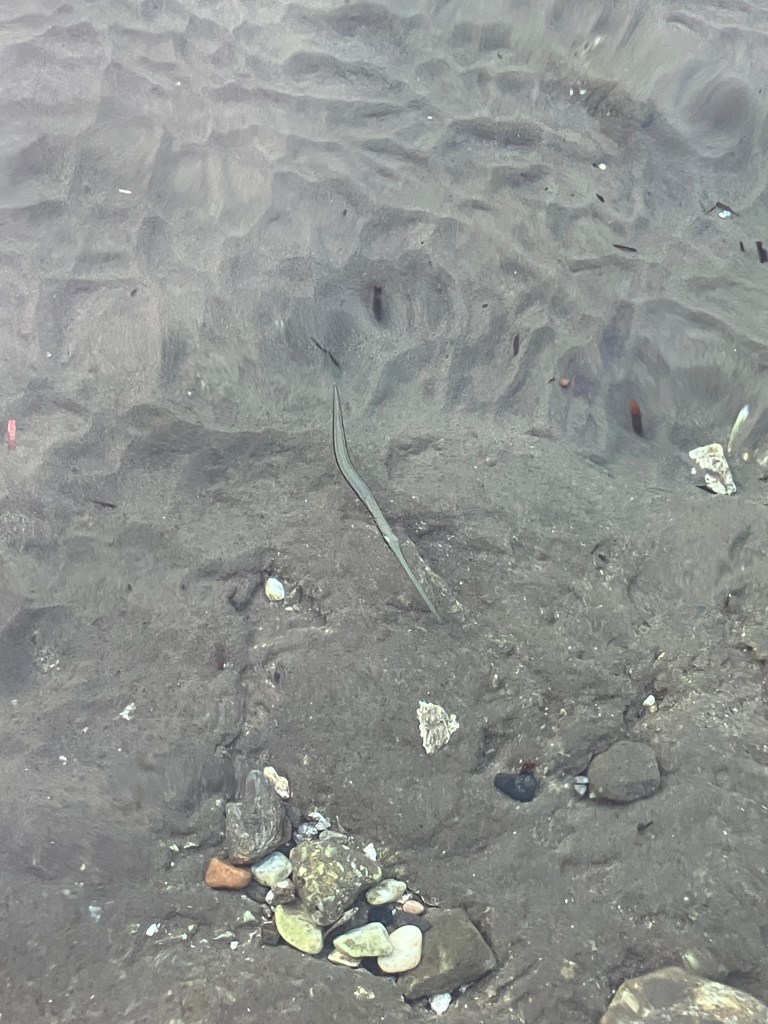
While exploring the rocky coastline of Apollon, Naxos, we encountered a fascinating but formidable visitor: the Bluespotted Cornetfish (Fistularia commersonii). This highly invasive species—easily recognized by its elongated, flute-like body and whip-like tail filament—is a prime example of changing marine ecosystems.
The “Alien Sprinter” of the Mediterranean
Also known as the flutemouth, this predator is a textbook “Lessepsian migrant”. Originally native to the Indo-Pacific, it entered the Mediterranean through the Suez Canal shortly after the year 2000. Taking advantage of warming waters, it became one of the fastest-spreading invasive fish in the region.
What Makes Them So Successful?
- Voracious Appetite: They are rapacious ambush predators that feed mostly on small fish and crustaceans. Studies show that a large portion of their diet consists of juvenile native fish, which creates direct competition for local fisheries.
- No Natural Predators: In their new environment, they have virtually no natural enemies to keep their populations in check.
- Quick Disguise: They are brilliantly camouflaged. Their bodies are typically greenish-grey with electric blue spots, but they can quickly shift to broad, dark stripes when resting.
Spotting One on Your Dives
While snorkeling or diving around Naxos, you might spot them hovering over sandy bottoms or near seagrass beds (like Posidonia) next to rocky reefs. Because of their slender shape (they can reach up to 1 to 1.5 meters in length), they often glide through the water like a shadow, easily sucking up small fish with their long, tubular snout.
While it’s always thrilling to spot such a unique creature, their rapid population growth remains a growing concern for Mediterranean biodiversity. You can read more about the environmental impacts of Lessepsian migrants on the Archipelagos website.
Bibliography
- https://projectmanaia.at/projects/invasive-species/
- First Mediterranean Record (2000):
Golani, D. (2000). First record of the cornetfish Fistularia commersonii (Fistulariidae) in the Mediterranean. Scientia Marina, 64(1), 107–110. - Rate of Spread & Colonization Speed (1,000–1,500 km/year):
Azzurro, E., Soto, S., Garofalo, G., & Maynou, F. (2013). Fistularia commersonii in the Mediterranean Sea: Invasion history and distribution modeling based on presence-only records. Biological Invasions, 15(5), 977–990. View Study Profile via FAO AGRIS. - Dietary Impact & “Lessepsian Sprinter” Status:
Karachle, P. K., Triantaphyllidis, C., & Stergiou, K. I. (2004). Bluespotted cornetfish, Fistularia commersonii Rüppell, 1838: A Lessepsian sprinter. Acta Ichthyologica et Piscatoria, 34(1), 103–108. Read Content on ResearchGate. - Predation on Lionfish & Ecosystem Dynamics:
Bariche, M. (2013). Fishes of the Mediterranean: Red Sea invaders and their ecological impacts. CIESM Atlas of Exotic Species in the Mediterranean. Access CIESM Digital Archive. - General Invasiveness Summary:
CABI Compendium. (2023). Fistularia commersonii (bluespotted cornetfish). CAB International. Read Global Profile on CABI Digital Library.
South Aegean Abundance Indicators
- Dominant Invasive Biomass: In regional small-scale fisheries studies across the South Aegean, the Bluespotted Cornetfish consistently ranks as one of the top three invasive species with the highest overall biomass in nets.
- High Catch Volumes: While scientists rarely count individual fish in the wild, localized impact studies nearby (such as in Rhodes) easily capture hundreds of specimens at a time (e.g., sample cohorts of 200–300+ individuals) for biological testing. This confirms a highly established, dense population throughout the surrounding Cyclades plateau.
- Massive Dietary Footprint: Studies show that the local population is thriving because over 70% of its diet consists of high-value native Greek fish species like picarel (Spicara smaris), bogue (Boops boops), and red mullets.
- The Next Wave: Showing just how comfortable the family has become in the Central Aegean, scientists in 2024 officially recorded the arrival of its sister species, the Red Cornetfish (Fistularia petimba), right next door to Naxos on the island of Amorgos.
If you want to read further about them, check out the Hellenic Network on Aquatic Invasive Species (ELNAIS), which maps these ongoing population explosions across the Greek islands.

