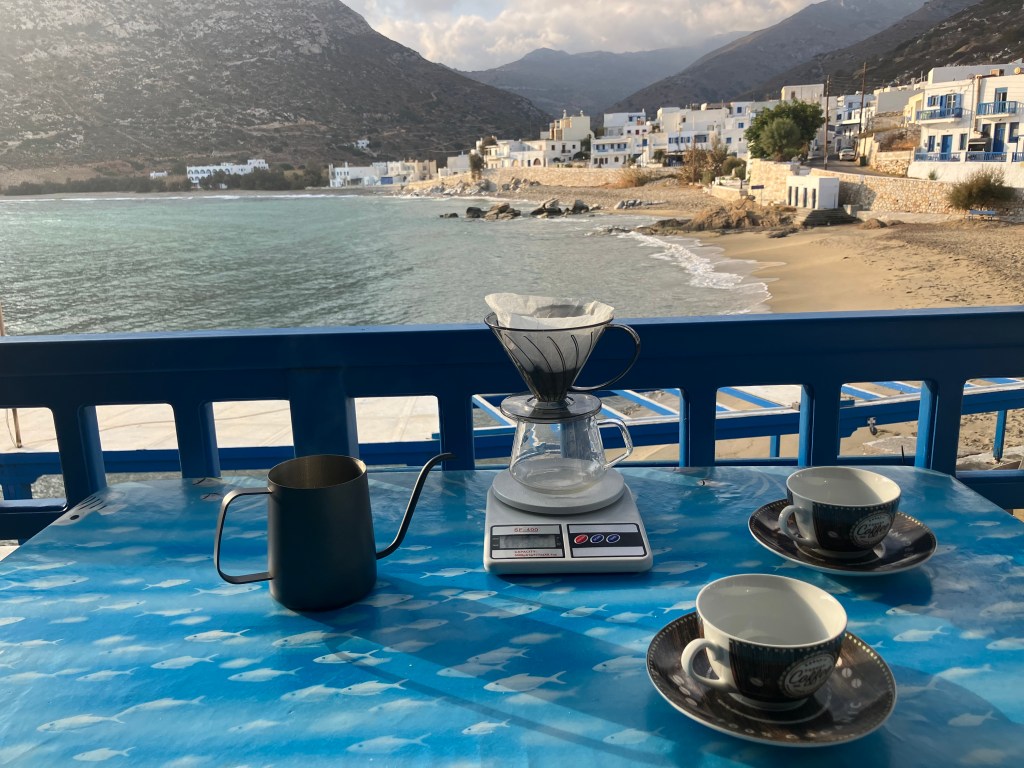
Before we dive in the pour over, first we need to clarify that what is called filter or drip coffee is indeed the same “method” but being automatic. With that said, if you have an automatic drip brewer, you will most probably get a repeatedly good brew (providing you put the right amount of coffee, good quality coffee and the right quantity (as well quality) of water. The water temperature will be always the same that your machine works with due to the temperature regulation is has.
Pour over puts a lot of spotlights in the skills of the person that performs the pour over and of course there is a lot of space for experimenting with your coffee beans. Pour over lets you control all the different phases of the brewing process and adjusting it properly to what you wish to taste. This is also the benefit of pour over, that gives you the possibility of influencing your coffee. But more about experimenting in the end of the post.
In this post we will not talk at all about roasting styles, different brewing methods or coffee equipment. These topics are far too extensive. Here we will just gather information about pour over and check out our coffee guide for more info. But we do plan to write a couple more posts about those topics.
So the pour over method is the manual process of pouring hot water in a filter/brewer that contains coarsely ground coffee while you keep on continuously extracting coffee. The coffee then drips inside your cup or carafe. This makes it a quite fast brewing method.
This is what you need:
- A kitchen scale (or a coffee scale where you can have also a timer)
- A kettle (or a gooseneck kettle for better control (precision and consistent flow rate) of the water pouring but you could simpky use a basic tea kettle, that has a gooseneck)
- A timer (you can use your mobile phone to keep the times though)
- Pour over brewer (loooots of different types out there)
- Coffee carafe (or your mug, if your pour over is just for you)
- Optional but quite important is a coffee grinder. You could be buying though already pour over coffee grounds
Coffee to water ratio
The recommended ratio from the specialty coffee association is a 1:18 coffee to water, which means 1gr of coffee for 18gr of water.
The ratio range though in general would be from 1:14 to 1:20.
Coffee calculator:
https://coffeebros.com/pages/coffee-to-water-ratio-calculator
The phases of pour over
- Blooming of the coffee
When you add the first water in your coffee grounds and you wet it, this is called blooming (or also wetting).
The bubbles that you will see when you add the first quantity of water is the carbon dioxide CO2 that is going away from the coffee grounds (light roasting has more CO2 trapped than dark roasted beans).
When you are in this first phase of brewing you need to add enough water to wet all your coffee grounds. You will notice that your coffee grounds will absorb water and will inflate/rise.
Then you wait. Waiting time varies from 30 seconds to 1 minute depending on the method/steps you are following. You need to give enough time for the gas to escape.
The longer you see bubbles, the less consistent you watered your coffee grounds. So some coffee grounds got wet later than others.
- Dissolution
Now that the coffee grounds are wet, the hot water that is being poured can dissolve the solutes or solubles that are inside the coffee beans´ cells.
The tasty solubles dissolve faster than the untasty ones. But you still need to find the moment, that only the tasty ones are inside your drink via osmosis. What osmosis does is, that takes out of the cell wall structure (which is a semi-permeable membrane) the solubles and this leads to the solubles entering a more watery environment, our brew. So every time we add hot water, we rinse the dissolved coffee solids into your carafe.
As a quick example, when you do a French press (immersion brew), since the coffee is inside water, then the coffee is fully saturated, cause it is inside the brew water.
- Diffusion
In this step the solubles are being transported to your drink in the carafe.
general steps
- Weight and heat your water (temperature can vary between 85-98 °C. Hotter means smoky flavors and cooler means sweetest flavors)
- Weight your coffee beans (ideal starting point is 30gr of coffee to 500ml of water)
- Grind your coffee (one of the most important variables influencing flavor and strength. The finer the grind, more surface for the brewing to extract the coffee flavors. Too coarse will not extract the flavor solids from the bigger particles, which leads to a weal and sour taste. Too fine means astringent, bitter and strong coffee.)
- Rinse your filter (with warm water to remove residuals, to temper it, to rinse any papery flavor taste and make it adjust properly if you are using paper filters) and the brewing carafe (to pre-heat it)
- Add coffee to the filter (and place it on your carafe and the carafe on the scale)
- Bloom (rule of thump is using twice as much water as the coffee grounds weight and wait for the release of CO2 before moving forward. Saturate the coffee bed evenly in order to achieve balanced flavors)
- Keep time and quantities ready for you to follow (you should brew between 2, 5 and 5 minutes. Longer you get more astringent notes and less, you didn´t really extract the essence of the coffee grounds. Have in mind to use small streams of water, 100gr in 10 sec, drain for 10-15 sec and repeat before the coffee grounds get exposed to air.)
- Enjoy your brew! (after the last addition of water, the dripping should finish in max a minute)
Pouring method
How often and the way (height and the motions you follow) you are going to pour will make a difference in your brew.
You could
- be making just one but slow/long pour.
- a pour with a frequency: xx grams in yy seconds.
- pour approximately 1 cm higher than your grounds and try to keep a consistent flow.
Recipes to try or start
There is a plethora of pour over recipes out there. We chose 3 famous recipes to have here as a starting point: The Scott Rao, the Lance Hendrick and the James Hoffman ones.
Scott Rao (V60 Method – he recommend the plastic one)
- medium coarse grinding
- 1:16.36 ratio (22gr of coffee-360gr of water and for the bloom he uses 3 times more water than coffee and mix it with a spoon)
- Water temperature: 85 – 100°C
- Bloom size: 3x the weight of your coffee with water.
- Bloom length: 45 seconds
- Remaining pour: After the bloom is complete, pour the remaining water in one long pour keeping a consistent height of your kettle at all times. Give your coffee bed a stir or spin at around 1:45 seconds to help with the flow.
- Total time: 3:15
Video recommendation: Pour below the height giving you splashing
This is a more recent video: updated pour over technique (Kalita wave)
Lance Hendrick
- medium coarse grinding
- 1:14 (darker roasts) – 1:17 (lighter roasts) range of ratios
- Water temperature: 85 – 100°C
- Bloom size: 3x the weight of your coffee with water. If you are using 20 grams of coffee, use 60 grams of water for your bloom.
- Bloom length: 1 – 2 minutes – user bloom time closer to 2 minutes if the coffee is fresh off roast.
- Remaining pour: After the bloom is complete, pour the remaining water at 6-8 grams a second until you hit the final weight. If the coffee is draining too slowly, it is okay to swirl the bed of coffee to help improve the flow rate.
- Total time 2-4 minutes (depending on the duration of the blooming: 1 or 2 minutes)
James Hoffman
- medium-fine grinding
- 1:16 ratio (this recipe calls for 15 grams of coffee meaning 250 grams of water)
- Water temperature: 85 – 100°C
- Bloom size: 3.3x the weight of your coffee. For this recipe it would call for 50 grams of water for your bloom.
- Bloom length: 45 seconds
- Remaining pour: After the bloom is complete, pour 50 grams of water every 20 seconds until you reach your final weight.
- Total time: 3:00 minutes
Video recommendation: Pour circularly
Important info:
- If you transport water from one vessel to another expect to get 10 °C less.
- Grinding right before brewing doesn´t allow your beans to get oxidized (cause they are exposed to air/oxygene)
- Pouring should occur in steady spirals in order to wet the grounds evenly
- Keeping notes of your brewing details will help you decide which parameters you can change and what exactly is being influenced from the changes of the parameters.
- Adding agitations makes the extraction faster
- If you are extracting mainly from the center you might have astringent, bitter and sour altogether meaning that you make an unbalanced brew. This is because you overextract the center (astringent and bitter) while you leave the outside coffee beans underextracted (sour).
- You want to get a flattened coffee bed. Work on your grinding and pour over technique to get it. That would mean also that you didn´t have any chaneling.
Wanna experiment?
There is a lot of space for experimenting here. Quantity of coffee (ratio of coffee to water), timings/brew length and quantities of the water added (brew time), different brewers, different filters, different grinding of the beans (grind size), different temperature of the water, different water quality (using filters or bottled water-although we are strongly against it, due to the waste it produces), swirling and the way of water agitation or not /wetting and so on.
In our places at Naxos we have a filter/drip coffee machine but also a manual dripper, in case you wanna do some pour over. Of course you have as well and ibrik and always coffee grounds to make a greek coffee.
References
- https://www.seriouseats.com/make-better-pourover-coffee-how-pourover-works-temperature-timing
- https://www.seriouseats.com/best-pourover-coffee-makers-5441631
- https://www.stumptowncoffee.com/blogs/news/how-to-perfect-your-pourover?srsltid=AfmBOoqB0S4MjDGjzv5Mgk6-9Iv3v6MMbX6wahNlNmwOceRiXJc4oM9M
- https://www.stumptowncoffee.com/pages/brew-guide
- https://coffeebros.com/blogs/coffee/the-perfect-pour-over-guide?srsltid=AfmBOopG__RfRuuDRjVsgyq8QAQsbamtTEnWxmBfq_-VzDL-CvEtU4Ia
- https://www.seriouseats.com/make-better-pourover-coffee-how-pourover-works-temperature-timing
- https://counterculturecoffee.com/blogs/counter-culture-coffee/guide-to-pour-over-coffee?srsltid=AfmBOop2lw3WinjMNGc-D5g9PLP5kkKV-6–LhHhoHIWua_Oa3DU8yrV
 Yannis and Stella @Apollon, Naxos