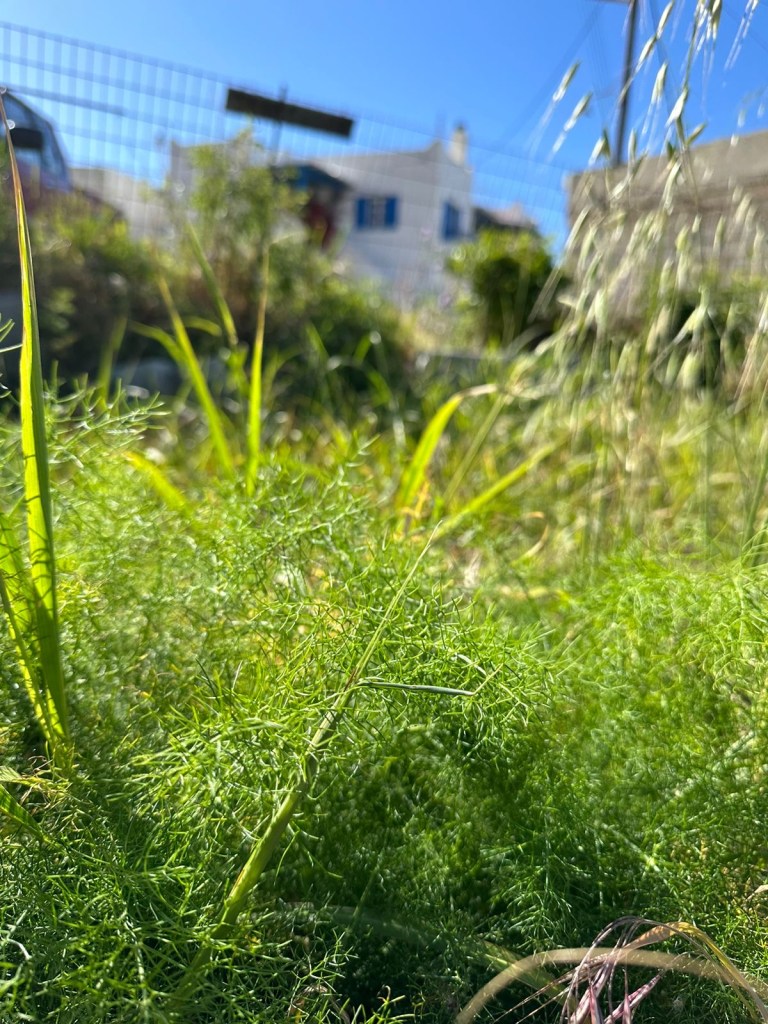
The scientific name of wild fennel is Foeniculum vulgare. The one that we find at the super market and we also eat part of the root is Foeniculym azoricum. Fennel has a yellow flower head with lots of tiny flowers.
This plant is very often being confused with dill cause they look like. We will make one more post about the two plants and help you recognize them. Fennels´ seeds can also be confused with anise.
The wild plant has a very strong smell and it is said, that the Marathon place in Greece (where the famous competition of running started), took its name from its fields full of fennel, cause fennel in greek is “maratho”. It is a perennial plant with thinner leaves than dill.
In spanish is called hinojo, in italian finocchio and in german Fenchel.
The taste is slightly sweet and can be used in baking, with meat or fish.
All the parts of the plant are edible. The foliage/leaves, the bulb and the seeds.
With the leaves you can make fantastic pies and the traditional Easter Sunday dish is actually goat filled with rice and fennel. The root can be added in salads or can be baked in the oven giving to the house a wonderful smell and the seeds can be added in pastry but also make a hot tea with them. In September you can collect the seeds from the dried pods.
In ancient Greece but also Rome it was used as medicine. There are also lots of researches regarding the therapeutic characteristics of fennel. We include some in the end of the post. In the next weeks we will post also recipes using fennel. Stay tuned.
Only to give some examples, there is a very tasty pie filled with fennel from Syros, it can be used with black eyed beans and we will of course publish the salty cookies we make with fennel.
Fennel is widely used also in Italy and there are for example the famous sausages with fennel.
In the next weeks, we will share more recipes with fennel. When you are at Apollon is the perfect moment to make them!
Bibliography:
- https://www.gastronomos.gr/agora/proionta/marathos-agrios-i-spartos/53718/
- https://en.wikipedia.org/wiki/Fennel
- https://www.vita4you.gr/blog-vita4you/el/item/marathos-idiotites-kai-parenergeies-toy-votanoy.html
- https://www.cretangastronomy.gr/2021/05/maratha-sillogh-diatirisi/
Scientific articles
- Fennel (Foeniculum vulgare) and Fenugreek (Trigonella foenum-graecum) Tea Drinking Suppresses Subjective Short-term Appetite in Overweight Women
- Foeniculum vulgare Mill: A Review of Its Botany, Phytochemistry, Pharmacology, Contemporary Application, and Toxicology
- Effect of Foeniculum vulgare Mill. (fennel) on menopausal symptoms in postmenopausal women: a randomized, triple-blind, placebo-controlled trial
- Effect of Fennel on the Health Status of Menopausal Women: A Systematic and Meta-analysis
 Yannis and Stella @Apollon, Naxos